

By Jim Turner, The News Service of Florida
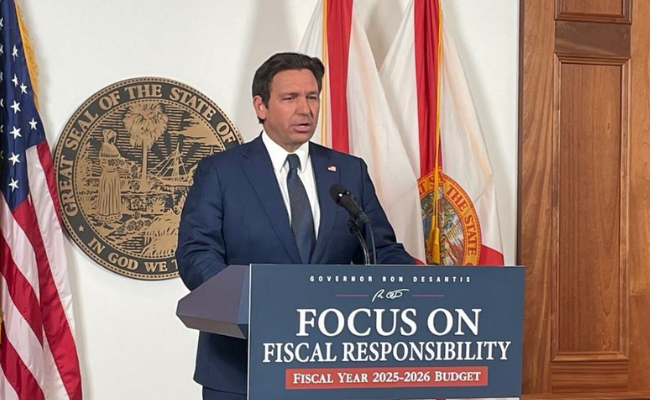
Florida utility customers won’t bear the additional costs brought by new large scale data centers that power artificial intelligence, under a bill signed by Gov. Ron DeSantis on Thursday.
The new law (SB 484) was part of DeSantis’ push to impose regulations on AI. The other plank of his plan, aimed at protecting consumers from AI harms, failed to draw full legislative support in his final regular session and a recent special session.
“You should not pay one more red cent for electricity because of a hyper-scale data center as an individual,” DeSantis said during the bill signing event at Florida Polytechnic University in Lakeland. “That’s just not right for the most wealthy companies in the history of the world to come in and have individual Floridians or Americans subsidize these hyper-scale data centers.”
DeSantis has considered the measure both “watered down” and “a pretty strong first step.” He disputes job creation numbers promoted by supporters of such facilities and worries about the future effect on humanity from maturing AI technology.
“There’s a lot of things that I’m excited about with respect to technology,” DeSantis said Thursday. “Some of the things you can do with defense and robotics, and medical research, and things like that. But a lot of the power that it is being used is for consumer-facing slop.”
The data center bill requires the Florida Public Service Commission, which regulates electric utilities, to develop what are known as “tariffs” and service requirements to “reasonably ensure that each large load customer bears its own full cost of service and that such cost is not shifted to the general body of ratepayers.”
That would include costs related to connecting to electric systems and increased power transmission and generation costs.
The measure reinforces the ability of local governments to refuse to build data centers in their jurisdictions. But it also allows city and county governments enter into non-disclosure agreements with tech companies for up to 12 months, which would hide data center proposals from the public during that time.
During committee hearings, business lobbying groups raised concerns the centers are being overregulated, with additional permitting not required for other large industrial users, which could offset any economic benefit.
While the data center bill passed through the Legislature, another bill containing the harsher requirements on AI companies, known as the AI Bill of Rights, was thwarted in the House.
House Speaker Daniel Perez, R-Miami, repeatedly professed that such individual protections should be addressed by the federal government.
The capacity for the large-scale data centers to consumer vast amounts of water and impose new burdens on electric grids was the center of debate over the bill.
Speaking before a Senate committee in February, bill sponsor Sen. Bryan Avila, R-Miami Springs, said his proposal is aimed at helping Floridians avoid issues already experienced in other states like Virginia, where ratepayers have seen “dramatic increases” with the arrival of the massive, energy-demanding data centers.
“The Global demand for data center capacity will triple by 2030 and it anticipates there will be a 20 to 25 percent annual growth of data center capacity within the United States during that time,” Avila said in reference to a 2025 report from McKinsey & Company.
The DeSantis administration has already taken a skeptical approach to new large data centers.
After the Fort Meade City Commission approved a development agreement in April for a 4.4 million square foot center to be located on the site of a former phosphate mine that is expected to use up to 50,000 gallons of water a day, Secretary of Commerce Alex Kelly questioned the project and called it “fundamentally flawed.”
“This makes very, very clear in a number of ways that our water resources are a public resource, a local resource, a state resource, a precious resource, and they should never be at the mercy of what sounds like a quick deal,” Kelly said of the legislation Thursday.




Be the first to leave a comment on this article.