

Taxable sales growth across Florida’s largest counties has slowed sharply since October 2025, with several once-fast-growing local economies now showing outright declines, according to a new analysis of Florida Department of Revenue data. However, the consumption economies of several Florida counties have proven to be resilient during these challenging times.
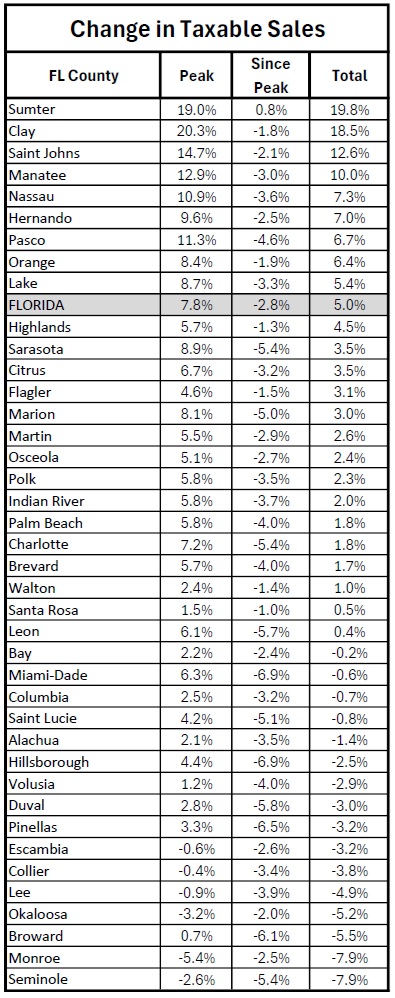
The analysis compares 12-month average taxable sales growth from December 2022 through October 2025 — labeled as the “peak” period — with growth since October 2025, when the national economy began slowing. The “total” column combines both periods to show which local economies have remained resilient despite the downturn.
Statewide, taxable sales growth during the “peak” period was 7.8%. Since the peak, growth has declined 2.8%, for a net growth rate over the period of 5.0%.
Among Florida counties, Sumter County posted the strongest peak-period growth at 19.0%, followed closely by Clay County at 20.3%. Saint Johns County ranked third at 14.7%, while Manatee County recorded 12.9% growth and Pasco County posted 11.3%.
Several counties in Central and Northeast Florida dominated the peak growth rankings, reflecting strong population gains and consumer spending during the post-pandemic expansion.
At the opposite end, Monroe County experienced the weakest peak growth at negative 5.4%, followed by Okaloosa County at negative 3.2%, Seminole County at negative 2.6%, Lee County at negative 0.9%, and Escambia County at negative 0.6%.
Since the October 2025 slowdown, however, nearly every county has experienced declining taxable sales growth. The counties hit hardest by the downturn were Miami-Dade and Hillsborough counties, each showing a 6.9% decline since the peak. Pinellas County followed with a 6.5% drop, while Broward County posted a 6.1% decline and Duval County fell 5.8%.
Leon County also saw a notable decline of 5.7% since October 2025.
Tourism-heavy counties were particularly vulnerable during the slowdown. Monroe, Sarasota, Charlotte, and Seminole counties all posted declines exceeding 5% after the peak period.
Despite the economic slowdown, several counties still maintained positive overall taxable sales growth, indicating stronger consumer activity and comparatively resilient local economies.
Sumter County led the state with a total gain of 19.8%, followed by Clay County at 18.5% and Saint Johns County at 12.6%. Manatee County remained strong at 10.0%, while Nassau County posted 7.3% total growth.
Other counties that stayed in positive territory included Orange, Lake, Sarasota, Marion, Palm Beach, Brevard, Walton, Santa Rosa, and Leon counties, though some showed only modest gains after recent declines.
The statewide total remained positive at 5.0%, suggesting Florida’s economy overall continues to outperform many states despite weaker consumer spending trends.
Still, a growing number of counties have now slipped into negative territory on the combined measure. Broward County posted a total decline of 5.5%, Lee County fell 4.9%, and Seminole and Monroe counties each recorded a negative 7.9% total change — the weakest overall performance among the counties analyzed.
The data highlights a widening divide between counties that continue benefiting from population growth and in-migration and those more dependent on tourism, discretionary spending, or slower-growing local economies.


Be the first to leave a comment on this article.