


Leon County added more than 1,700 business establishments between 2019 and 2025, posting one of the strongest growth rates among a group of comparable Florida counties and outpacing the statewide average. In addition, the business establishments added were almost all created by the private sector.
TR has previously published an analysis which showed that Leon County’s job growth during this period ranked 37th and the annual wages ranked 13th.
According to data from the U.S. Bureau of Labor Statistics’ Quarterly Census of Employment and Wages (QCEW), Leon County’s number of business establishments increased from 9,155 in 2019 to 10,868 in 2025. That represents a gain of 1,713 establishments, or 18.7%, ranking sixth among 11 peer counties.
For comparison purposes, the peer group includes counties that produced between 100,000 and 200,000 jobs in 2019.
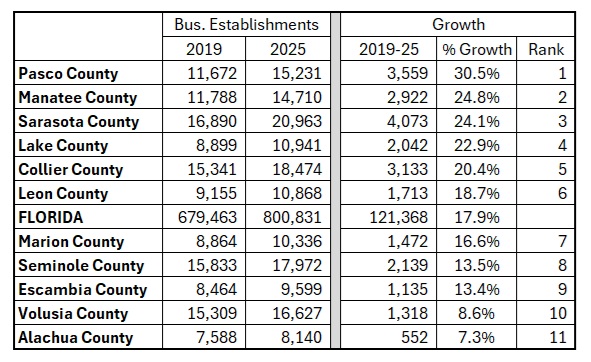
Only Pasco County (30.5%), Manatee County (24.8%), Sarasota County (24.1%), Lake County (22.9%) and Collier County (20.4%) recorded faster growth during the six-year period.
Leon County’s growth also exceeded the statewide average. Across Florida, business establishments increased from 679,463 to 800,831, a gain of 121,368 establishments, or 17.9%. Leon County’s 18.7% increase was nearly one percentage point higher than the state’s overall growth rate.
Among the counties trailing Leon were Marion (16.6%), Seminole (13.5%), Escambia (13.4%), Volusia (8.6%) and Alachua (7.3%).
The figures come from the Quarterly Census of Employment and Wages (QCEW), widely regarded as the nation’s most comprehensive source of local employment and business data. Unlike surveys that rely on statistical sampling, QCEW is based on unemployment insurance records submitted by employers and covers approximately 95% of U.S. wage and salary jobs, making it one of the most accurate measures of local economic activity.
In QCEW data, an establishment is a single physical business location where economic activity occurs, such as a retail store, restaurant, manufacturing plant, office, medical clinic or warehouse. A single company may operate multiple establishments—for example, a retailer with 10 stores would be counted as 10 establishments. As a result, establishment growth measures the expansion in the number of business locations rather than the number of companies.
Economists often view growth in business establishments as a key indicator of economic vitality because it reflects business formation, expansion and investment within a community. When combined with employment and wage growth, establishment growth provides a broader picture of the strength and diversity of a local economy.




Be the first to leave a comment on this article.