

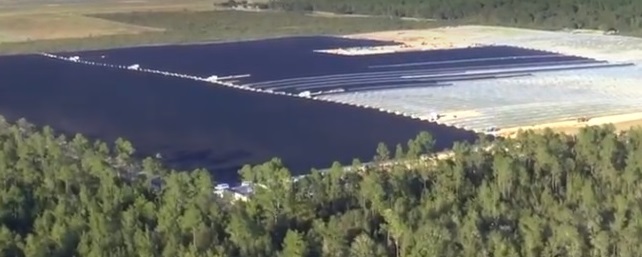
The City of Tallahassee’s Electric and Gas Utility is moving forward with plans to significantly expand renewable energy generation and battery storage capacity by the end of the decade, as city officials consider the next steps in evaluating six proposed projects from private vendors.
Elected officials voted 3-2 to approve the plan during the April 15th city commission meeting.
Commissioner Jeremy Matlow voiced concerns about the lack of specificity in the plan and voted against the item, as did Commissioner Jack Porter. Mayor Daily and Commissioners Dianne Williams-Cox and Curtis Richardson supported the item.
Operating as the municipally owned utility for more than 120,000 customers in and around Tallahassee, the city utility will begin detailed engineering and financial studies that will determine whether the projects are feasible and cost-effective. The projects could be online as early as 2029.
Utility staff say the proposed solar and energy storage investments are intended to provide price stability, diversify fuel sources, strengthen grid reliability, and enhance long-term energy security. The projects also offer faster construction timelines compared to traditional power generation facilities.
The initiative stems from the utility’s long-range Integrated Resource Planning process released in 2023, which found that increasing solar generation—paired with battery storage—could help stabilize energy costs while improving system resilience. Currently, nearly five percent of the community’s energy needs are supplied through existing solar agreements totaling 62 megawatts, with the majority of power still generated by natural gas.
In July 2025, the utility issued a Request for Information to gauge interest from renewable energy developers and technology providers. Fourteen vendors responded, offering solutions ranging from solar and battery systems to biomass and waste-to-energy generation. Based on those responses, staff determined that utility-scale solar and battery storage represented the most viable options for near-term expansion.
A formal Request for Proposals followed in October 2025, resulting in 25 proposals from 11 vendors across three categories: solar-only projects, solar paired with energy storage, and standalone battery storage facilities. After technical and cost evaluations, a selection committee recommended six project sites involving five companies.
Among the proposals are plans for solar farms ranging from 15 to nearly 75 megawatts and battery storage systems capable of storing between 40 and 168 megawatt-hours of electricity. Several projects would connect to the utility’s grid near the Tallahassee International Airport and on the southeastern and southern sides of the service area.
City officials emphasize that plan approval does not guarantee construction. Instead, it authorizes the next phase of feasibility, system impact, and facility studies—an essential step in determining how new generation sources would affect the electric grid and customer rates.
Funding for the initial studies, estimated at just over $1 million, is already available through the city’s Solar Capacity Expansion project budget.
Commissioners are expected to weigh the benefits of expanding renewable capacity against the costs of further analysis, as the utility continues planning for future energy demand in a rapidly changing market.


Be the first to leave a comment on this article.