

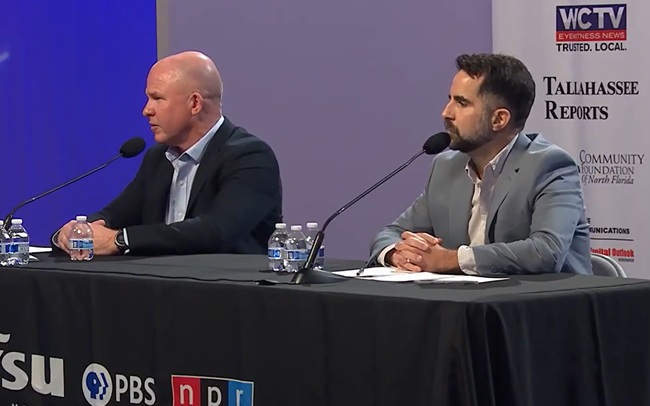
Candidates Tom Derzypolski and P.J. Perez faced questions on city leadership, development, affordability, public safety, the economy, housing, utilities and partisan politics during a Tallahassee City Commission Seat 3 candidate forum. The seat is currently held by City Commissioner Jeremy Matlow.
The forum was produced by the Capitol Region News Collaborative and the League of Women Voters of Tallahassee. Questioners included representatives from WTXL, the Tallahassee Democrat and the League of Women Voters.
Below is a condensed question-and-answer summary of the forum, with significant differences between the candidates highlighted.
How would your leadership differ from Commissioner Jeremy Matlow?
Tom Derzypolski: Said he would bring 25 years of executive and community leadership experience and emphasized his political independence. He said he is not aligned with other candidates and would work with whoever voters elect to move the city forward.
P.J. Perez: Emphasized his 16 years in public education and his family’s experience in both the public and private sectors. He said his priorities include neighborhoods, small businesses, environmental protection and opportunities for residents he believes have been overlooked.
Key Difference: Derzypolski framed the race around experience, independence and changing the governing culture at City Hall. Perez framed his candidacy around policy change and greater representation for neighborhoods and residents he believes have been underserved.
What is the main difference between you and your opponent?
Derzypolski: Experience. He pointed to 25 years of executive leadership, community relationships and experience addressing complex problems.
Perez: Perspective. He cited his career in education, his wife’s small business and his work with students and families.
Key Difference: Derzypolski argued that executive experience distinguishes him. Perez emphasized his public-education background and connection to working families.
Would you have supported the transfer of Tallahassee Memorial HealthCare to FSU?
Perez: No. He supported an affiliation with FSU but opposed transferring the asset. He criticized the process and said alternatives proposed by residents were not adequately explored.
Derzypolski: Yes, with reservations. He supported bringing an academic medical center to Tallahassee but strongly criticized the process as predetermined and insufficiently transparent. He favored stronger local governance and participation by FAMU and Tallahassee State College.
Key Difference: This was one of the forum’s clearest policy differences. Derzypolski supported the ultimate TMH-FSU transaction despite concerns about the process. Perez opposed transferring the asset and preferred an affiliation that retained city ownership.
Would you have supported selling the Capital City Country Club property?
Derzypolski: No. He criticized selling city assets and described the transaction as a “fire sale.”
Perez: No. He argued the city should have retained the 178-acre property and considered financing maintenance through bonds. He also cited the historical significance of graves of enslaved people on the property.
Did you support the process used to hire the new city manager and the supermajority termination provision?
Perez: No. He said the city charter contemplates the manager serving at the pleasure of the commission and criticized requiring a supermajority to remove the manager.
Derzypolski: Opposed the contract provision but said the city ultimately hired a highly qualified manager. He attributed the controversy partly to the commission’s “toxic culture,” arguing threats to fire the manager prompted other commissioners to seek additional protections.
Key Difference: Both opposed the contract provision, but Perez focused on the charter and the structural problem with the supermajority requirement. Derzypolski placed the controversy within the broader context of dysfunction and mistrust among commissioners.
Do you support hyperscale data centers in Tallahassee?
Derzypolski: No, under current circumstances. He said too many questions remain concerning environmental effects, economic benefits, jobs and salaries.
Perez: No. He supports a moratorium, citing environmental concerns, water use, tax incentives and skepticism about promised job creation.
What is causing local gun violence, and what would you do about it?
Perez: Said young people lack opportunities and a sense of purpose. He advocated after-school music and arts programs, vocational training, Head Start and early intervention.
Derzypolski: Cited gangs, broken homes, struggling neighborhoods and limited economic opportunity. He called for better coordination among law enforcement, nonprofits and community organizations, along with neighborhood revitalization and economic development.
Key Difference: Perez placed greater emphasis on youth programs and early intervention, while Derzypolski emphasized coordination, neighborhood revitalization and economic opportunity.
Do you support Flock cameras and license-plate surveillance technology?
Derzypolski: Expressed serious reservations. He said law enforcement should have effective technology but only with strict oversight and protections for civil liberties.
Perez: Criticized the city’s handling of automated license-plate readers and warned that surveillance technology can be misused. He emphasized balancing public safety against civil liberties.
Should the city and county operate separate fire departments?
Perez: No. He said city and county leaders should repair their relationship and restore cooperation, with firefighters involved in developing a solution.
Derzypolski: No. He called separate systems unaffordable and said he would immediately work toward mediation and restoration of a joint approach.
Do you support the 287(g) agreement with ICE?
Derzypolski: No. He said it creates anxiety and makes the community less safe.
Perez: No. He characterized the arrangement as federal overreach and said residents should not be treated as enemies.
Both said they would have voted to sever the agreement even if doing so exposed them to possible action by the governor.
What has been Tallahassee’s biggest economic-development success of the past four years?
Derzypolski: Said he could not identify one and characterized local economic development as “anemic.”
Perez: Also said substantial work remains. He called for greater support of small businesses and better commercialization of research and innovation from FSU, FAMU and TSC.
How do residents perceive Tallahassee’s economy?
Perez: Said voters he encounters are primarily concerned about affordability—rent, utilities and household expenses—not City Hall’s political divisions. He linked affordability to his opposition to urban sprawl.
Derzypolski: Said residents are experiencing genuine financial pressure and sometimes must choose among food, gasoline and prescriptions. He proposed reducing city-controlled utility rates and fees where possible.
Key Difference: Both described an affordability problem, but Perez connected it more directly to development patterns and urban sprawl, while Derzypolski emphasized reducing government-controlled household costs and growing the economy.
How would you create higher-income jobs?
Derzypolski: Would leverage FSU, FAMU, TSC, Lively, the academic medical center and the National High Magnetic Field Laboratory to attract private investment. He said government needs to operate at the “speed of business.”
Perez: Would use university research and student talent to develop commercially useful solutions to community problems, including water-quality challenges.
Key Difference: Derzypolski emphasized business recruitment and connecting private industry with Tallahassee’s existing institutions. Perez emphasized commercializing locally generated research and innovation.
What is Tallahassee’s most important environmental issue?
Perez: Water quality. He connected threats to water resources with urban sprawl and inadequate infrastructure.
Derzypolski: Water quality. He warned about the influence of large national developers and advocated cooperation among environmental groups, neighborhoods and local builders.
Give examples of responsible and irresponsible growth.
Derzypolski: Pointed to urban infill and affordable housing in existing neighborhoods as responsible growth. He criticized development pushing farther away from the urban core because of infrastructure costs.
Perez: Cited the Tallahassee Lenders’ Consortium’s Community Land Trust as a positive model. He criticized the proposed Lake Jackson-area annexation and Welaunee-area expansion as examples of sprawl that shift infrastructure costs to taxpayers.
Key Difference: Both favor infill, but Perez was more explicit in opposing specific Northeast development and annexation projects. Derzypolski focused more broadly on the financial and infrastructure advantages of developing inside the existing urban area.
Who is responsible for the City Commission’s 3-2 divide and “toxic” culture?
Perez: Downplayed the significance of what he called “palace intrigue,” saying most residents are more concerned about affordability and responsive government. He said disagreement among commissioners can be part of a healthy governing body.
Derzypolski: Said dysfunction matters because it prevents progress on affordability, crime, environmental issues and growth. He said he would work to restore civility and collegiality.
Key Difference: This was a fundamental difference. Derzypolski views City Hall’s political dysfunction as a major problem requiring a change in leadership style. Perez argues the 3-2 narrative receives too much attention compared with residents’ economic and policy concerns.
Is Democratic Party involvement in the nonpartisan Seat 3 race appropriate?
The candidates were asked specifically about the Leon County Democratic Party, chaired by Ryan Ray, who also works as Commissioner Jeremy Matlow’s aide, supporting Perez.
Derzypolski: Said voters want to move beyond partisan labels. He declined to make the ethical determination concerning Ray and Matlow himself.
Perez: Said party affiliation inevitably provides information to voters even in nonpartisan elections. He highlighted Derzypolski’s roughly two decades as a registered Republican.
Key Difference: Perez considers partisan history relevant information in a nominally nonpartisan election. Derzypolski argues the contest should be judged primarily on candidates, leadership and independence rather than party affiliation.
Is Republican criticism tying Perez to out-of-town socialists fair?
Perez: No. He dismissed such attacks as political “boogeymen” and “McCarthyism.”
Derzypolski: No. He rejected the attacks, said they did not help his campaign and called on people to stop them.
What does Derzypolski say about his former Republican registration?
Derzypolski: Said his voting history demonstrates independence, pointing to support for Democrats including Bill Montford, Allison Tant and Loranne Ausley. He said becoming NPA better reflected his political outlook.
Perez: Said voters should consider Derzypolski’s approximately 20 years as a Republican, including during Donald Trump’s presidencies. Perez said he consistently voted Democratic despite previously registering NPA.
Key Difference: Derzypolski portrays his former Republican registration as less important than his history of crossing party lines. Perez portrays the duration of Derzypolski’s Republican affiliation as relevant information about his political background.
What progressive position does Derzypolski hold?
Derzypolski: Said access to health care should be a basic right and also identified environmental protection.
Would Perez create a new progressive 3-2 voting bloc?
Perez: Said voters should judge his published policies rather than political labels and vote based on whether those policies reflect their values.
Derzypolski: Said party-based concerns are overrated in a nonpartisan election and emphasized his independence.
Key Difference: Perez defended the policies associated with his candidacy without distancing himself from the progressive coalition supporting him. Derzypolski made independence from political groups and voting blocs a central argument for his candidacy.
Name an issue where Perez disagrees with Commissioner Jeremy Matlow.
Perez: Said he had not studied Matlow’s complete eight-year voting record closely enough to identify a specific vote. He suggested affordable housing could be an area of difference, citing his support for a Montgomery County-style approach.
Key Difference: The exchange underscored one of Derzypolski’s broader campaign arguments: Perez did not identify a specific Matlow vote he opposed, while Derzypolski repeatedly presented himself as independent of the existing City Commission factions.
What about Derzypolski’s support from developers, builders and Chamber interests?
Derzypolski: Said his donor support reflects relationships and trust developed through 25 years of community service. He also pointed to support from retirees, veterans, teachers and environmentalists.
Perez: Said criticism is warranted to the extent those interests have influenced decisions that frustrate voters. He contrasted his individual donor base with contributions associated with business and development interests.
Key Difference: Derzypolski portrays business and development support as evidence of broad community trust. Perez portrays support from those interests as potentially tying a candidate to the same forces he believes have shaped City Hall decisions.
Does Perez bear responsibility for the fake Facebook operation targeting Talethia Edwards?
Perez: Said consultant Kris Estanga acted independently. Perez said he would not have made that decision but believes people make mistakes and deserve second chances.
Derzypolski: Said the incident may be history in terms of the news cycle but remains relevant from a leadership perspective. He questioned how such activity could occur within a campaign’s orbit without the candidate knowing.
Key Difference: Perez treats the incident as the independent mistake of a consultant and largely a closed matter. Derzypolski treats it as an ongoing question about leadership, campaign culture and accountability.
How would you reduce utility costs?
Perez: Proposed removing the fire-services fee from utility bills and replacing it with an assessment-based approach. He also questioned other fees appearing on utility bills.
Derzypolski: Promised to lower utility bills during his first year and cited reconnection and after-hours charges as examples of fees that could be reconsidered.
Key Difference: Perez proposed changing how major city services are financed. Derzypolski focused more heavily on reducing fees and other city-controlled costs charged directly to utility customers.
If you could do one thing to make housing more affordable, what would it be?
Derzypolski: Prioritized expedited permitting for urban infill to increase affordable housing supply in existing neighborhoods.
Perez: Proposed eliminating parking minimums, streamlining permitting, expanding community land trusts, legalizing “missing middle” housing and encouraging smaller starter homes.
Key Difference: Both support infill and additional housing supply, but Perez proposed broader zoning and housing-policy changes, while Derzypolski emphasized permitting reform and private-sector construction within existing neighborhoods.
Does increasing housing supply reduce prices?
Perez: Generally yes, but said the type of housing matters. He argued that building additional luxury student apartments does not necessarily address affordability for working families.
Derzypolski: Agreed that housing type matters and again emphasized urban infill and neighborhood revitalization.
Do you support Amendment 3?
Derzypolski: No. He said it would shift power from local governments to the state and could create severe fiscal problems for cities and counties.
Perez: No. He likewise characterized it as an attack on home rule that could particularly hurt rural communities and reduce local government’s ability to provide services.
What would you do if Amendment 3 creates an $18 million annual city revenue loss?
Perez: Said he would target executive “bloat,” development subsidies, travel, licensing expenses and other spending while reviewing the budget line by line.
Derzypolski: Also advocated a line-by-line budget review. He argued that city revenues have expanded substantially and that government could return spending closer to previous levels while protecting public safety.
Key Difference: Perez identified particular programs and spending categories he would target, including development subsidies. Derzypolski made a broader fiscal argument that city government has expanded and should reduce overall spending toward earlier levels.
Do you support an across-the-board 4% employee raise?
Derzypolski: No. He prefers compensation based on employee performance.
Perez: Said across-the-board increases should incorporate merit-based standards.
Should the commission remove the 30-minute limit on off-agenda public comment?
Perez: Yes.
Derzypolski: Yes.
Who do you support for governor?
Both candidates said they planned to vote for David Jolly.
Who do you support for Tallahassee mayor?
Perez: Said he would vote for Commissioner Jeremy Matlow.
Derzypolski: Said he had not decided and would evaluate the candidates based on who could best serve Tallahassee. He said he was prepared to work with either candidate.
Key Difference: Perez explicitly backed Matlow, reinforcing his political alignment with the existing progressive coalition. Derzypolski declined to choose between the mayoral candidates and again emphasized his political independence.
Do you support city-county consolidation?
Derzypolski: No. He questioned whether consolidation produces sufficient savings to justify the disruption.
Perez: No. He similarly said the savings do not justify the complications involved.
Name a position held by your opponent that you respect.
Perez: Said he appreciates Derzypolski’s emphasis on concerns about urban sprawl.
Derzypolski: Said he agrees with Perez’s emphasis on urban infill and neighborhood revitalization.
What should outside PACs supporting your candidacy do?
Perez: Said supporters do not need to tear down opponents and emphasized that candidates will remain neighbors after the election.
Derzypolski: Said he would publicly stand alongside Perez to reject false attacks against him and said dark-money and outside-money attacks have no place in his leadership.
How would you improve Tallahassee International Airport?
Derzypolski: Focused on costs, particularly parking, arguing that high airport expenses encourage residents and businesses to drive to competing airports.
Perez: Favored attracting more budget airlines and studying successful airport strategies in similarly sized communities.
Key Difference: Derzypolski focused on reducing the cost of using the existing airport, while Perez emphasized increasing airline competition and flight options.
Should StarMetro services be cut during a revenue shortfall?
Perez: Indicated no, describing public transportation as a public good rather than a profit-making enterprise.
Derzypolski: Did not advocate service cuts. Instead, he proposed restoring commercial advertising on buses to generate additional revenue.
Key Difference: Perez emphasized preserving transit because of its role as a public service. Derzypolski emphasized finding new revenue to help sustain the service without relying entirely on city funding.
What was each candidate’s closing argument?
Derzypolski: Presented himself as the independent and experienced candidate. He emphasized 25 years of executive and community leadership, bridge-building and his willingness to work with all commissioners. He said Tallahassee voters are looking for “independent thought and leadership.”
Perez: Presented himself as the change candidate. He argued Tallahassee needs a “clean break with the status quo” and criticized the influence of “monied interests.” He emphasized his grassroots campaign, affordable housing and government responsiveness to neighborhoods.
Key Difference: The closing statements captured the central contrast of the forum: Derzypolski argued that Tallahassee needs independent, experienced leadership capable of repairing a divided City Hall. Perez argued that Tallahassee needs a policy and political break from the existing power structure and development interests.




PAC's should be made illegal.
*
To improve the Airport, all the Fee's need to either STOP or be Reduced a lot.
*
YES, bring back Advertising on the City Busses. ALSO sell Advertising Space on the School Busses.
"Perez argues the 3-2 narrative receives too much attention" ............................ Not when the SAME 3-2 Votes are about 85% of the Votes.
*
"Perez: Said party affiliation inevitably provides information to voters even in nonpartisan elections." .................... BUT, that Information was WRONG.
*
"Perez portrays support from developers, builders and Chamber interests as potentially tying a candidate to the same forces he believes have shaped City Hall decisions." ............................ Hmmm, maybe you should study all the Monthly Financial Reports of all the City (and County) Candidates running for Local Office. I have.