

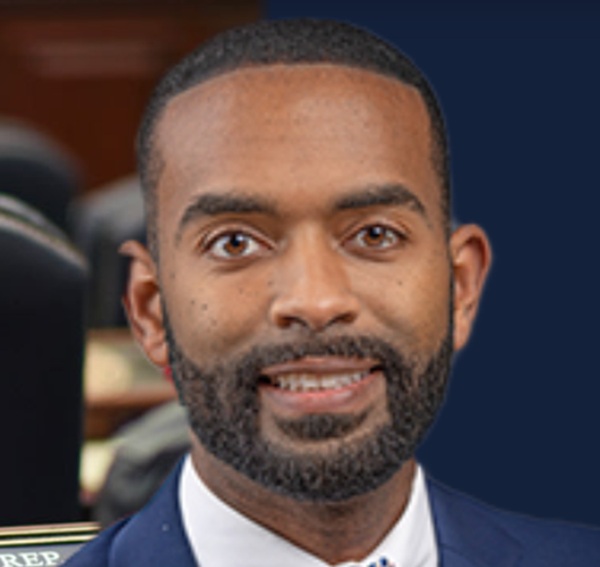
By Ana Goñi-Lessan, The News Service of Florida
Rep. Gallop Franklin, D-Tallahassee, is in line to become House Democratic Leader for the 2028-2030 legislative term.
Until then, he wants the Democratic Party’s platform to focus on one important issue: the economy.
“We’ve always had a messaging challenge promoting and talking about our economic wins,” he said.
Franklin spoke to the News Service of Florida about the upcoming midterm elections, his view on the importance of live debates and the role pharmacies play in public health.
Q: What are the major challenges the Democratic Party faces in these midterm elections?
FRANKLIN: I would say our messaging is always a challenge. If you look historically at how well the economy does when Democrats are governing, on average, the economy’s doing better.
So you look at Bill Clinton compared to his predecessor, George H. W. Bush. You look at Bill Clinton in comparison to the person who came after him, George W. Bush. Look at President Barack Obama, who came after George W. Bush. You even look at how well the economy was doing under President Joe Biden. And now you look at how it’s going under President Donald Trump. What polling used to tell us, even during the 2024 election cycle, was for some reason, people would equate a working economy under Republican leadership and governance. What that tells me is that we’ve always had a messaging challenge promoting and talking about our economic wins.
Q: What issues do you see pulling people from the middle to the left? And why?
FRANKLIN: If you look at polling, they’re starting to now say they believe that Democrats are better with the economy than Republicans. As Republicans have been governing, we’ve been hit with inflation and lost wages. You see now, typically you’re watching Republican candidates really harping on culture war type of issues. If you notice most of the Democratic candidates are starting to message what we always should have been messaging, which is, we’re better at this economy thing than they are. I think, based on what we’ve done historically, that’s what’s bringing people to the left. What’s unfortunate is that the economy has to always get this bad for everyday citizens to wake up and listen to our economy talk. In 2024, we could talk about the economy until we were blue in the face, and it seemed like the electorate was more focused on culture issues. But once the party currently in power kind of gets us to where we are and people are feeling the squeeze of the economy, those issues are allowing people to start moving toward the left.
Q: It looks like we won’t see live, in-person debates between candidates at the top of the ticket in Florida this year. What’s your opinion on that?
FRANKLIN: My personal opinion is that it doesn’t take a debate to understand where someone is on the issues. You can go to a town hall, you can ask questions, you look at their website, you can see what they’re talking about and what they’re always focused on. You can also look at their record. So I never thought that a debate was really about getting to know where a person stands in full transparency. The reason why I think the electorate typically wants a debate is because you almost get to turn politics into a boxing match. You get to say cool zingers to get back at someone. And I’m not saying that people should not debate, I’ve always debated. I’ve never turned down a debate. I’m not saying that it doesn’t give people a sense of your personality. It gives people a sense of executive presence. I think all those things are important, right? People like seeing how you respond under pressure, how you think on your feet. People like being able to understand what it’s like when you’re negotiating in real time with another world leader. What will that look like? What a debate kind of does is brings those skill sets to the front of the television so that people can kind of see if you can be the leader of the free world or the great state of Florida.
Q: What are the Democratic priorities for the 2027 session?
FRANKLIN: Rep. Christine Hunschofsky is going to be the minority leader starting in January 2027, and she’s going to be leading us through that charge. So I can’t speak for her, but what I can say is, from the outside looking in, and seeing how Christine has been conducting the campaign cycle and how she’s been recruiting, I will say her focus has been on the economy. Ensuring that we can fight down property insurance costs, making sure we can address inflation, investing in educational opportunities to try to grow our economy, right? It looks like, without a doubt, it has to do with growing the economy, slowing inflation, and making sure we can drive down costs.
Q: You’re a pharmacist. The Florida Department of Health just recently is allowing pharmacists to administer the vaccine for chikungunya, as the state has seen a spike in cases. Could you comment on local pharmacies’ role in public health?
FRANKLIN: Pharmacists are somewhere in everyone’s neighborhood, and so we’re normally the fastest access to health care services. Also, pharmacists undergo tons of training and tons of school that makes them capable of being able to provide vaccines at any level. Oftentimes, you might ask the question, why can’t pharmacists give all vaccines? And that really comes down to we have state statutes that limit the ability of what pharmacists can do. But I can say there’s tons of states out there that allow pharmacists to do much more than what they currently do here in Florida. You see these expansions, like the COVID vaccine or other vaccines for different outbreaks. When there’s a public health concern, they know for sure that pharmacists have the capability to do these things safely. And because pharmacists are oftentimes more accessible, as in, it’s easier to walk into a pharmacist and get a shot, than to have to get an appointment and then show up.


Be the first to leave a comment on this article.