

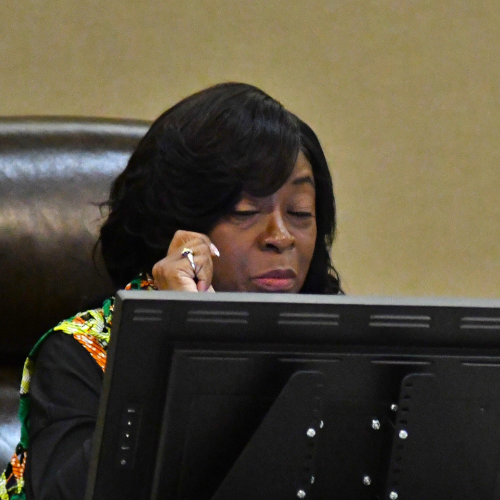
An analysis of Tallahassee’s City Commission Seat 5 election results shows that strong support in Northeast Tallahassee propelled incumbent Dianne Williams-Cox to victory over progressive challenger Dot Inman-Johnson, despite a political environment that helped elect Jeremy Matlow as mayor.
Williams-Cox received 35,804 votes (51.7%) compared to Inman-Johnson’s 33,433 votes (48.3%), a margin of 2,371 votes, according to the district-level election analysis.
The geographic breakdown reveals significant differences between the Seat 5 contest and the mayoral race, particularly in Southside and student neighborhoods where Matlow accumulated substantial margins over Loranne Ausley.
District 1 – Southside
Williams-Cox narrowly carried District 1, which includes predominantly Black neighborhoods on Tallahassee’s Southside, receiving 50.7% of the vote compared to Inman-Johnson’s 49.3%. Her margin was just 192 votes.
The result contrasts sharply with the mayoral election, where Matlow defeated Ausley by 2,222 votes, receiving 57.8% of the district’s vote.
The nearly even division in the Seat 5 race suggests that Williams-Cox maintained support among Southside voters who favored Matlow in the mayoral contest.
This was a critical difference between the two races. While Matlow built a substantial advantage on the Southside, Inman-Johnson was unable to generate a similar margin.
District 2 – Student Areas
Inman-Johnson’s strongest percentage came in District 2, which includes Florida State University and surrounding student neighborhoods.
Inman-Johnson received 53.1% of the vote, defeating Williams-Cox by 589 votes.
However, Matlow performed significantly better in the same district, receiving 64.6% of the vote and defeating Ausley by 2,856 votes.
The difference of 11.5 percentage points between Matlow’s and Inman-Johnson’s support indicates that a substantial portion of voters who supported Matlow did not extend that support to Inman-Johnson. This was particularly consequential because District 2 provided Matlow with his largest district margin in the mayoral race.
District 3 – Waverly, Betton Hills Area
Williams-Cox carried District 3, which includes the Waverly and Betton Hills neighborhoods, receiving 51% compared to Inman-Johnson’s 49%, a margin of 288 votes.
The results closely mirrored the mayoral contest, where Ausley received 51.6% compared to Matlow’s 48.4%, winning by 485 votes.
Both contests indicate that District 3 continues to provide a modest advantage to more moderate candidates, although neither Williams-Cox nor Ausley established a decisive margin.
District 4 – Northeast Tallahassee
Williams-Cox’s strongest performance came in the more conservative Northeast neighborhoods, including Killearn and Summerbrooke.
Williams-Cox received 60.2% of the vote, defeating Inman-Johnson by 2,700 votes.
In the mayoral contest, Ausley performed even better, receiving 62.5% and defeating Matlow by 3,598 votes.
The results demonstrate that Northeast Tallahassee remains a stronghold for candidates opposing the progressive slate.
Importantly, Williams-Cox’s 2,700-vote advantage in District 4 exceeded her citywide victory margin of 2,371 votes. Without the substantial Northeast margin, Williams-Cox would have lost the election.
District 5 – Eastside
Inman-Johnson narrowly carried District 5, which includes neighborhoods east of downtown along the Mahan Drive and Apalachee Parkway corridors.
Inman-Johnson received 50.6% of the vote, defeating Williams-Cox by 220 votes.
Matlow also carried District 5, receiving 51% and defeating Ausley by 370 votes.
The similar results suggest that the Eastside remains competitive territory, with a slight advantage for progressive candidates.
The Bottom Line
The biggest difference between the Seat 5 and mayoral races was the performance of progressive candidates in Districts 1 and 2.
Matlow accumulated a combined 5,078-vote advantage in the Southside and student districts. Inman-Johnson, by comparison, managed a combined advantage of only 397 votes in those same districts.
That represents a 4,681-vote difference in the two progressive candidates’ combined margins across these districts.
Meanwhile, Williams-Cox received enough support in Northeast Tallahassee to overcome her losses in Districts 2 and 5, while narrowly winning Districts 1 and 3.
The outcome also highlights the continuing political importance of Northeast Tallahassee. While the Northeast margin was insufficient to deliver a mayoral victory for Ausley, it proved decisive in Williams-Cox’s reelection.
For future city elections, the results suggest that strong Southside and student-area support will remain essential for progressive candidates seeking to overcome the substantial margins more moderate candidates continue to receive in Northeast Tallahassee.



Be the first to leave a comment on this article.