

By: Gray Roher, The News Service of Florida
Florida’s inquiry into OpenAI’s involvement in the mass shooting at Florida State University last year is now a criminal investigation, Attorney General James Uthmeier announced Tuesday.
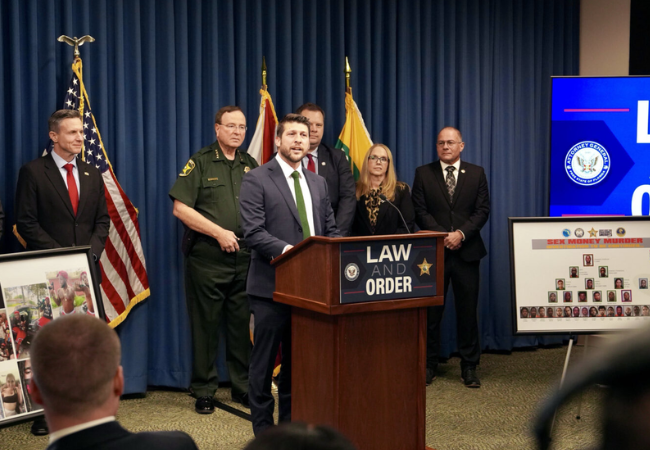
“Unfortunately, what we’ve seen in our initial review is that ChatGPT offered significant advice to the shooter before he committed such heinous crimes,” Uthmeier told reporters at a news conference in Tampa.
ChatGPT is a chatbot product offered by OpenAI, a California-based artificial intelligence company.
Investigators into the April 17, 2025 shooting at FSU that took two lives and injured five others say they’ve uncovered records showing suspect Phoenix Ikner asking ChatGPT about the best gun, ammunition, the optimal time and place on FSU’s campus to kill the most people – and receiving answers.
“My prosecutors have looked at this and they’ve told me if it was a person on the other end of that screen we would be charging them with murder,” Uthmeier said.
The move comes two weeks after Uthmeier revealed the state’s initial investigation into OpenAI, which deals with the FSU incident and other instances of ChatGPT’s possible assistance in teen suicides and facilitating child pornography. That probe remains ongoing, Uthmeier said.
For the criminal investigation, Uthmeier said his office was issuing subpoenas to OpenAI on Tuesday seeking information on its policies and internal training materials on user threats, cooperation with law enforcement and reporting crimes, going back to March 2024.
Attempts to reach OpenAI representatives Tuesday were unsuccessful.
Earlier this month OpenAI released a framework for states to change their laws to prevent abuses of AI.
Uthmeier acknowledged his criminal investigation of a company is unusual, but he argued, it’s necessary.
“We recognize here with OpenAI we’re venturing into uncharted territory, but we need to know whether or not OpenAI has criminal liability,” Uthmeier said.
The investigation is the latest sign of the skepticism of Florida’s leaders toward AI.
Gov. Ron DeSantis has warned of the potential pitfalls of embracing AI without proper safeguards in place, and called on lawmakers to pass an “AI Bill of Rights” to protect consumers.
But DeSantis’ fellow Republican leaders in the House rejected the bill this year, even as the Senate approved it. House Speaker Daniel Perez, R-Miami, has said he prefers to let the federal government formulate regulations for the burgeoning AI field, in line with an executive order President Donald Trump signed seeking to thwart state-level AI laws.
DeSantis, though, has said that order won’t hinder Florida’s push for tighter regulations on AI.
Lawmakers did pass a measure putting more stringent requirements on massive data centers, which require large amounts of electricity and water to provide the power AI needs to operate.
Last week Department of Commerce Secretary Alex Kelly warned local officials in Fort Meade a proposed AI data center there is “fundamentally flawed” and threatens the local water supply.



Be the first to leave a comment on this article.