

By Gray Rohrer, The News Service of Florida
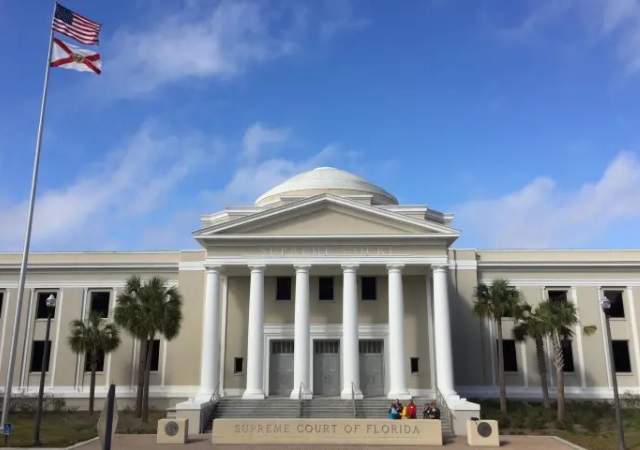
The Florida Supreme Court on Thursday heard arguments in a case involving whether a Panhandle couple has the right to sue a gun range next to their property over the noise it makes.
Adrienne and Eugene Gartman first filed their lawsuit against the Southern Tactical Range in 2018, when the sport shooting range set up shop adjacent to their property in the Okaloosa County town of Holt.
But a trial court threw out the suit because of a 1999 law that prevents sport shooting ranges from being sued over noise nuisances, if they were in compliance with any noise ordinances in place at the time they were built or started operating. Okaloosa County has no noise ordinance.
The Gartmans appealed, claiming the law should be struck down because it violates the state constitution’s protections for people to have access to the courts for redress of an injury. A three-judge panel agreed with them, sending the matter to the state high court.
“From the very day this gun range opened my clients were powerless to do anything to stop the gun range or to take care of their noise problems which have rendered their property virtually unmarketable,” Charles Bell, the Gartmans’ attorney, argued.
The justices probed both Bell and Alan Lawson, who represented Southern Tactical Range.
Justice John Couriel pushed Lawson on whether the statute was written too broadly, and whether a more “narrowly tailored” law would still be able to protect gun ranges from exorbitant lawsuits without violating the constitutional right of access to the courts.
“It seems to me that in this case it is not a barrier to certain types of claims, it is a full stop barrier to any accountability at law,” Couriel said.
Lawson noted the law requires gun ranges to be compliant with existing noise ordinances.
Justices also questioned Lawson about a 1973 precedent that requires the Legislature to spell out an “overwhelming public necessity” when infringing on a constitutional right.
While lawmakers didn’t do so for the statute in question, they did outline the necessity to protect gun ranges from lawsuits in a different 2004 law, Lawson noted.
“These statutes are more than closely related; they are inextricably intertwined,” Lawson argued.
Not so, Bell responded. The law didn’t provide findings or legislative intent outlining the importance of shielding gun ranges from suits brought over noise.
“The Legislature knows how to get around this, they know what to do. They know if they wanted to enact this law they could’ve included findings and talked about how important this is,” Bell said.
But the justices pushed Bell to defend how that argument squares with the presumption of legality that any challenged law carries.
“Why should the Legislature have to do that?” Justice Adam Tanenbaum asked Bell. “It seems odd from an originalist perspective that the people suddenly intended to freeze out the Legislature from ever regulating a certain set of rights.”
Although the appellate decision explicitly said it applied only to the Gartmans, Lawson argued if left intact by the Florida Supreme Court it would open gun ranges up to lawsuits that would threaten their existence.
“(The range) cannot operate without creating noise,” Lawson said. “The Legislature says we have to have them in this state, and they have to go somewhere.”


Be the first to leave a comment on this article.