

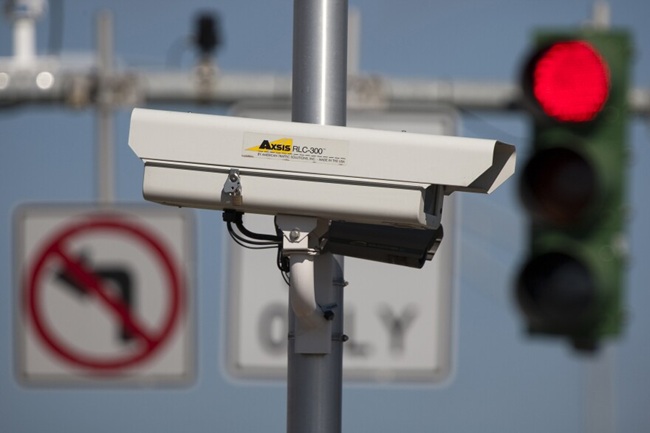
The Leon County Commission voted July 14 to reject a federal grant that would have expanded the use of Flock Safety automated license plate reader cameras in surrounding Big Bend counties, citing concerns over privacy, government surveillance and the collection of motorists’ data.
The grant, administered through the Leon County Sheriff’s Office, would have provided funding for Flock camera systems in Wakulla, Jefferson, Liberty and Taylor counties. Although the cameras were intended for installation outside Leon County, the proposal generated significant public opposition from residents who urged commissioners not to facilitate the technology’s expansion. Commissioners ultimately voted to remove the Flock funding from a larger homeland security grant package while approving the remaining grant requests.
Flock Safety’s automated license plate readers capture images of license plates and use artificial intelligence to identify a vehicle’s make, model, color, body style and other distinguishing features. Law enforcement agencies use the systems to investigate crimes, locate stolen vehicles and receive alerts when vehicles connected to criminal investigations are detected. Supporters say the technology has become an effective investigative tool, while critics argue it creates an expansive surveillance network capable of tracking the movements of law-abiding citizens.
Several residents spoke against the proposal during the commission meeting, raising concerns about privacy, civil liberties and the security of data collected by the camera network. Speakers questioned whether the benefits of the technology outweighed the risks associated with expanding automated surveillance and storing vehicle location data.
Commissioners echoed many of those concerns. Commissioner Christian Caban said he supports law enforcement but opposes the widespread deployment of automated license plate readers, describing the systems as an invasion of privacy. Other commissioners acknowledged the technology’s value in solving crimes but said they were uncomfortable with Leon County helping expand its use into neighboring jurisdictions.
The local debate reflects a broader national conversation over the balance between public safety and personal privacy. According to Flock Safety, its camera network is used by thousands of law enforcement agencies and communities across nearly every state to recover stolen vehicles, locate missing persons and assist criminal investigations. At the same time, organizations such as the Electronic Frontier Foundation and the American Civil Liberties Union have warned that widespread deployment of automated license plate readers can enable mass surveillance and raise concerns about data retention, access and misuse. Recent reviews of Flock camera programs in cities including Los Angeles have highlighted those same issues as agencies reconsider the technology’s privacy implications.
In addition to rejecting the grant, commissioners directed county staff to return in September with an analysis of whether Leon County has the legal authority to regulate, prohibit or require the removal of Flock cameras within the county. The review is expected to examine the county’s legal options as communities across Florida and the nation continue to debate the role of automated surveillance technology.

Be the first to leave a comment on this article.