

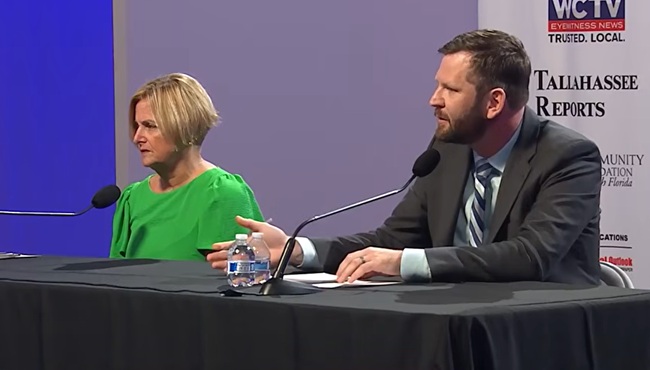
Tallahassee City Commissioner Jeremy Matlow and former state Sen. Loranne Ausley faced off Sept. 25 at 1 p.m. during an hour-long debate at WFSU Studios ahead of the Nov. 3 general election.
Provided below is a summary of answers to questions asked during the forum hosted by the media partners in the Capital Region News Collaborative, which includes Tallahassee Reports, and the League of Women Voters.
Are Tallahassee residents better off than four years ago?
Loranne Ausley: No. She said residents are angry and worried about the cost of groceries, gasoline and other necessities and are struggling to see how their circumstances can improve.
Jeremy Matlow: No. He pointed to high gasoline prices, Tallahassee’s roughly 25% poverty rate and the larger number of working residents struggling to make ends meet. He argued many residents do not believe government is looking out for their interests.
What is the clearest difference between you and your opponent?
Matlow: He described his candidacy as a break from the status quo, emphasizing grassroots support, opposition to “backroom deals,” developer influence and development he believes damages the environment.
Ausley: She identified three major differences: support for the Children’s Services Council, support for the TMH-FSU Health transaction despite concerns about the process, and differences in political leadership and culture. She criticized negative social-media tactics and anonymous political activity associated with people in Matlow’s political orbit.
Matlow response: He acknowledged opposing the Children’s Services Council tax while saying he supported creating a council.
What are your top two accomplishments?
Ausley: Securing state funding that helped begin the cleanup leading to Cascades Park and helping create Whole Child Leon, which she connected to the eventual creation of the Children’s Services Council.
Matlow: Adoption of Tallahassee’s clean-energy goal of transitioning to 100% renewable energy and bringing greater scrutiny to City Hall spending, decision-making and alleged wrongdoing.
Is your opponent capable of serving as Tallahassee’s chief ambassador?
Matlow: Yes. He said both he and Ausley are capable of representing Tallahassee. He emphasized his lifelong connection to the community and experience building a business here.
Ausley: She said she is prepared for the ambassadorial role but questioned Matlow’s attendance at civic events, citing his absence from the opening of the new senior center.
Matlow response: He said commissioners are sometimes excluded from events, noted that he supported the senior center, and said his responsibilities as a small-business owner also affect his schedule.
TMH-FSU Health transaction
Matlow: Opposed. He criticized the process, questioned whether taxpayers received fair market value and argued there was insufficient accountability regarding what FSU would ultimately deliver.
Ausley: Supported. She criticized how the transaction was handled but argued that an academic medical center would improve health care, create better jobs and benefit Tallahassee.
Key difference: Matlow emphasized process, accountability and valuation; Ausley emphasized the expected long-term health-care and economic benefits.
Sale of the Capital City Country Club property
Ausley: Would have supported the sale. She emphasized preservation of green space and recognition of ceremonial burial grounds and argued that maintaining a golf course preserves open space.
Matlow: Opposed. He argued that valuable public property was sold for substantially less than its value and raised concerns about the investors behind the transaction.
Data-center moratorium/ban
Matlow: Supported restricting large-scale data centers, citing water consumption, electrical demand, environmental concerns, land availability and relatively limited employment benefits.
Ausley: Agreed with Matlow that Tallahassee does not need large data centers, citing land constraints and limited job creation.
Hiring the new city manager and requiring a supermajority for termination
Ausley: Said the incoming commission should have made the city-manager decision and opposed the supermajority termination provision.
Matlow: Also argued that the new commission should have selected the manager. He went further, calling the timing a violation of public trust and arguing that the supermajority provision conflicts with the City Charter.
What is driving gun violence, and what should the city do?
Matlow: Focused on reaching young people early, creating productive activities and employment opportunities, measuring the effectiveness of violence-prevention programs and addressing poverty.
Ausley: Also emphasized youth intervention and community engagement, citing cooperation among law enforcement, pastors and community organizations.
Are current police staffing levels sufficient?
Ausley: Generally yes, although she said the city should examine community policing and potentially different forms of police involvement.
Matlow: Essentially yes, provided staffing is sufficient for police to answer calls and meet the levels identified by the police chief.
Does participation in the 287(g) immigration program make Tallahassee safer?
Matlow: No. He argued it makes the community less safe and cited his observations of an ICE enforcement action.
Ausley: Her answer was less definitive. She said immigration enforcement is necessary but stressed fairness and questioned the appropriate role of local police.
Should the city and county operate separate fire departments?
Ausley: No. She called for the city and county to resolve their funding dispute and preserve a unified fire service.
Matlow: No. He likewise argued that the governments should resolve their differences and maintain a unified system.
Do you support Flock license-plate cameras?
Matlow: No. He characterized the system as mass surveillance and raised concerns about tracking residents and outside access to collected information.
Ausley: Said surveillance technology has advanced faster than government safeguards. She supported the pause or moratorium until adequate protections are established.
Key difference: Matlow expressed more categorical opposition; Ausley emphasized the need for safeguards.
Should school-zone speed cameras remain?
Matlow: No. He said he opposed the program from the beginning and favors traditional enforcement and street-design changes around schools.
Ausley: Initially said she was uncertain about the relationship between speed cameras and license-plate surveillance, but after the discussion said she would vote to end the program.
Campaign Conduct and Political Culture
Is it appropriate for Matlow aide Ryan Ray to simultaneously serve as local Democratic Party chairman?
Matlow: Said he does not attempt to control employees’ political activities and that his expectation is that his aide properly performs his city job.
When specifically asked whether he had asked Ray about posting anonymous comments, Matlow said that was not part of Ray’s city commission role.
Ausley: Used the issue to make a broader argument about anonymous social-media activity, fake accounts and what she described as the political culture surrounding Matlow.
What responsibility does Matlow bear for the fake Facebook controversy involving his former campaign manager?
Matlow: Said the activity was unrelated to his campaign and involved another City Commission race. He argued that investigating candidates’ backgrounds is a legitimate function of independent media.
Ausley: Said Matlow’s response was inadequate. She argued leaders are responsible for setting standards for their teams and tied the episode to broader concerns about anonymous attacks and political culture.
This was one of the forum’s clearest personal/leadership contrasts.
Why should voters trust Ausley despite significant support from developers and business interests?
Ausley: Said she has received contributions from people across the political and economic spectrum throughout her career and that contributions do not purchase her vote or influence.
How did Matlow respond to criticism about progressive or socialist-aligned outside support?
Matlow: Identified himself as a Democrat and said Republican criticism of his Democratic affiliations is expected. He said voters should judge him by his record and Democratic values.
Do you support Amendment 3?
Ausley: No. She warned that the measure could significantly reduce Tallahassee revenue and threaten funding for essential services.
Matlow: No, but for different reasons. He opposed state interference in local budgeting while arguing that Tallahassee itself needs to reduce spending. He said the amendment’s consequences would be manageable but could simply shift costs elsewhere.
What happens if Amendment 3 passes?
Matlow: Said essential services would be protected. He would target development subsidies and other spending before reducing core services.
Ausley: Said the city would need to examine the entire budget for waste, duplication and administrative overhead while protecting police, parks, housing and other essential services.
Key difference: Both call for spending scrutiny, but Matlow identifies developer subsidies and executive spending as specific targets; Ausley emphasizes a broader budget review.
Has city government been overspending?
Ausley: Said that is a legitimate concern and called for examining waste, duplication and administrative overhead.
Matlow: Yes. He cited executive salaries, raises and expensive government vehicles as examples of spending that should be scrutinized.
Utilities and Renewable Energy
How should Tallahassee address high utility bills?
Matlow: Proposed reducing development-related utility subsidies, examining utility taxes and lowering general-fund spending to reduce pressure on electric rates.
Ausley: Said affordability and infrastructure investment both need examination and pledged to make utility costs a mayoral priority, although she offered fewer specific measures.
Do you support Tallahassee’s 2050 clean-energy commitment even if it raises rates?
Ausley: Yes. She said the clean-energy commitment is important and could help Tallahassee recruit residents and businesses.
Matlow: Strongly supports renewable energy but rejected the premise that it necessarily requires higher rates. He argued renewable energy could provide greater price stability and potentially lower bills.
Key difference: Ausley explicitly accepted the clean-energy goal despite the possibility of higher rates; Matlow argued the transition itself can ultimately lower or stabilize costs.
Housing
If you could take one action to improve housing affordability, what would it be?
Matlow: Build 500 municipal housing units during his first four years, using city-owned land, resources and permitting authority.
Ausley: Coordinate existing housing organizations and combine federal, state and local resources through organizations such as the housing authority, community land trust and lenders consortium.
Clear philosophical difference: Matlow proposes direct municipal production of housing; Ausley proposes coordination and leveraging existing housing institutions and funding.
City Commission Dysfunction
Does Matlow bear responsibility for the 3-2 split?
Matlow: He defended his approach, saying voters elected him to challenge City Hall practices. He emphasized that commissioners agree on roughly 87% of votes and said the disputes concern consequential matters such as development, taxes, environmental protection and public assets.
Who is responsible for City Hall dysfunction?
Ausley: “Everybody.” She said political anger and social media have worsened divisions and argued the next mayor should rebuild relationships and search for common ground.
Major contrast: Matlow largely views conflict as a consequence of substantive disagreements that require confrontation; Ausley emphasizes leadership style, relationships and consensus-building.
Most important environmental issue?
Matlow: Climate-driven extreme weather and clear-cutting/development of forested areas.
Ausley: Framed development around three tests: whether it provides needed housing or jobs, whether infrastructure exists to support it, and whether it protects Tallahassee’s water, tree canopy and quality of life.
Example of good and bad development?
Matlow: Praised small-scale urban infill such as community-land-trust housing on Wallace Street. Criticized the Thomasville Road storage development.
Ausley: Also criticized the appearance of the Thomasville Road project but noted that it proceeded under existing regulations, suggesting the city should change those regulations if residents dislike the resulting development.
How should the city improve economic mobility?
Matlow: Reform permitting and make city government a “front door” for entrepreneurs, particularly smaller local businesses. He favors shifting economic development away from primarily recruiting large corporations toward helping residents start businesses and obtain capital.
Ausley: Focus on recruiting employers offering higher-wage jobs across a range of skill levels. She emphasized making City Hall easier for businesses to navigate and having the mayor actively promote Tallahassee.
How is the Office of Economic Vitality performing?
Matlow: Wants OEV to focus more heavily on startups, local businesses and business recruitment while moving away from subsidies he considers questionable.
Ausley: Said OEV is “not doing great,” although she did not blame its employees. She suggested structural reform so the organization operates at the “speed of business” rather than the “speed of government.”
Agreement: Both candidates favor substantial changes to OEV, although their preferred economic-development emphasis differs.
How can Tallahassee make its airport more competitive?
Ausley: Explore partnerships and incentives involving state government, FSU and other institutions, while acknowledging there is no easy solution.
Matlow: Increase demand for travel to Tallahassee through arts, culture, live music, tourism and private-sector economic development.
Pedestrian and Bicycle Safety
Matlow: Prioritize safe pedestrian and bicycle infrastructure when allocating Blueprint and transportation dollars rather than concentrating resources on new road construction supporting development.
Ausley: Improve connectivity and safety of pedestrian paths, bicycle infrastructure and public transit.
StarMetro
Ausley: Opposed service cuts and argued Tallahassee needs a transit system that is useful not only to transit-dependent residents but attractive to the broader population.
Matlow: Opposed service reductions and called for increasing ridership, citing environmental and financial benefits.
Should Tallahassee and Leon County consolidate?
Ausley: No. She said she would vote against the consolidation straw poll while supporting cooperation and existing consolidated services.
Matlow: No. He characterized the proposal as effectively a county takeover of the city but said city-county cooperation should improve.



Be the first to leave a comment on this article.