


By Jay Waagmeester, The Florida Phoenix
State education officials amended the rules governing Schools of Hope, a program that was expanded at the end of the last legislative session and caused a stir in public schools around the state ever since.
The Florida Board of Education passed a rule Friday that would, among other things, limit the number of applications charter school operators hoping to colocate in traditional public school buildings may send to those districts to do so.
Hope Operators looking to take advantage of the program, now, under the amendments, can not submit more than five notices in one year.
Less than a week after the program’s expansion last fall, the Florida Policy Institute, a non-partisan research organization, reported that charter operators had sent 690 “letters of intent” to co-locate inside public schools in 22 counties.
Limiting applications “removes the possibility for a Hope Operator to be able to really flood the market with building notices,” Department of Education Senior Chancellor Paul Burns said.
The new rule requires that operators attest they intend to open a school when they apply, so that they’re not applying just to block other operators from locating in a specific building, since the program runs on a first-come-first-serve basis.
Board member Daniel Foganholi commended schools for speaking up about what can be amended in the rules.
Media reports around the state evidenced the panic that some districts went into when given a limited amount of time to respond to operators hoping to co-locate.
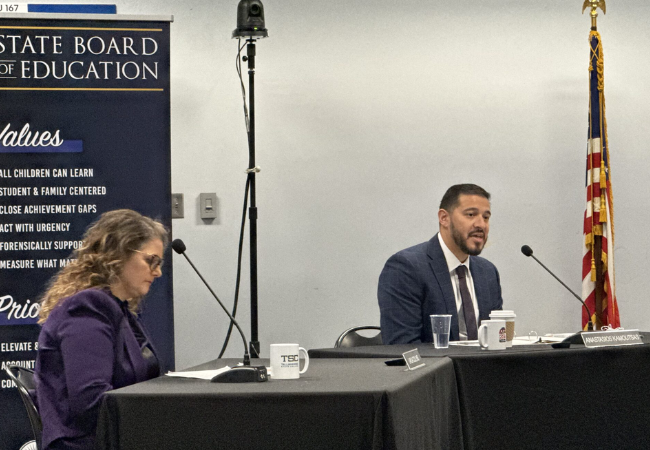
“It didn’t need to become a Twitter negative public spectacle. The idea here was this doesn’t even take effect until the ’27-’28 school year, so the hysteria was overly dramatized, but the adults in the room, the school board members who demonstrate true leadership skills and work with us behind the scenes to get this to a place that not just helps out the districts, but makes sure that students’ opportunities are not limited, I think this landed in a great spot,” Education Commissioner Anastasios Kamoutsas said during the board’s meeting Friday in Key West.
One concern voiced by opposing legislators last session and from other opponents of Schools of Hope is the cost put onto schools by the law.
The original law required traditional public schools provide “without limitation” custodial, maintenance, safety, food, nursing, and transportation services to schools of hope.
The change made Friday now stipulates that shared services would have to be “in a manner agreed upon in the Mutual Management Plan” agreed upon between the Hope operator and the school district. The proposal erases the language that stipulated the services be provided “without limitation” and provides the district the ability to charge for incremental costs of utilities used by the Hope Operator.
More amendments
- Defines schools at 90% or more facility capacity are “fully used,” excluding them from being deemed underused, vacant, or surplus. Previous language said fully used schools are those that do not have unused student stations.
- A facility is now eligible to host Schools of Hope if it has a facility use rate 75% or lower or has a surplus of at least 400 student stations.
- Schools of Hope are not be eligible to open inside buildings that opened within the past four years.
- Hope operators must notify schools at least one year in advance if they plan to open in a facility. In the notification, operators must indicate projected enrollment and that the reason for sending the notice is “not speculative or filed for the purpose of restricting access to available facilities.”
- Hope operators must have a college attendance rate at all of their high schools that exceeds 80% and more than 70% of its students qualify for free or reduced lunch.
- Districts would have 20 business days, rather than calendar days as establish in the original policy, to object to Hope operators’ request.

State Responds to Schools of Hope Outcry, Tightens Rules added by Staff on
View all posts by Staff →