
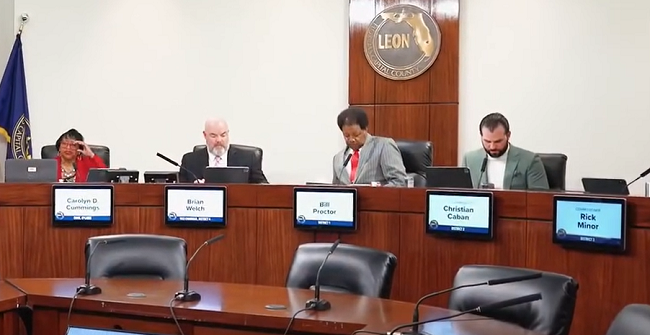


The Leon County Board of County Commissioners is weighing whether to ask voters next year if they support exploring the consolidation of Leon County and the City of Tallahassee governments.
At an upcoming meeting, commissioners will consider placing a nonbinding, countywide advisory referendum on the Nov. 3, 2026 General Election ballot to gauge public sentiment on potential consolidation. The so-called “straw ballot” would not create a unified government but would signal whether voters are open to the idea.
The proposal follows months of discussion. In November 2025, the board directed staff to analyze county-city consolidation in Florida and outline the legal process. A December 9 status report reviewed national and state experience, noting that full structural consolidations are rare and that evidence of cost savings and economic benefits is mixed.
In Florida, Jacksonville–Duval County remains the only successful example of a fully unified city-county government. Efforts elsewhere in the state have failed, including four previous attempts in Tallahassee–Leon County in 1971, 1973, 1976 and 1992. Past research found that local skepticism often centered on specific charter details — such as representation, treatment of constitutional officers and urban-rural balance — rather than outright opposition to consolidation.
The December report also highlighted the extent of existing “functional consolidation” between the city and county through joint programs. These include the Department of PLACE, the Tallahassee–Leon County Planning Department, the Office of Economic Vitality, Blueprint, the Consolidated Dispatch Agency and TLCGIS — partnerships designed to improve efficiency without fully merging governments.
Under Article VIII, Section 3 of the Florida Constitution, any formal consolidation would require a special act of the Legislature and subsequent voter approval of a consolidation charter. The advisory referendum now under consideration would not trigger that process but could inform future decisions.
Commissioners are being asked to choose between two alternative resolutions that would place slightly different ballot titles and summary language before voters. Both options would authorize the board chair to transmit the approved language to the Supervisor of Elections and require a neutral public information effort in compliance with state law. A third option would accept the report and take no further action.
If approved, the referendum would give voters their first formal say on consolidation in more than three decades.

Leon County to Consider Nonbinding Referendum on Consolidation added by Staff on
View all posts by Staff →