


By Mitch Perry, Florida Phoenix
The Florida House has passed a bill labeled by one Senate Democrat as the “nail in the coffin” for public sector unions in Florida.
The measure (SB 1296) would require that public sector labor unions could only be re-certified if at least 50% of all of the employees in the bargaining unit vote and that the vote itself wins 50% plus-one support. Currently, those unions only need a majority of those who voted.
The final tally was 73-37, with eight Republicans voting with every Democrat to oppose the measure. They were Michelle Salzman, Hillary Cassel, Jim Mooney, Susan Valdés, Omar Blanco, Chuck Brannan, Anne Gerwig, and Karen Gonzalez Pittman. Following its passage in the Senate last week, it will head to Gov. Ron DeSantis’ desk. He is expected to sign it into law.
“We have example after example where a bargaining unit represents hundreds or thousands of employees and only a handful show up and vote, and vote in favor of continuing the union,” said Rep. Jenna Persons-Mulicka, R-Fort Myers, who sponsored the bill in the House. “That is a problem, and that is the problem that we are now seeking to solve with this legislation.”
The measure has been fiercely contested by organized labor, which contends it could dramatically weaken or even dissolve unions throughout the state. Under the legislation, public safety unions are exempt from the new requirements. Those unions often support Republicans, while the bill targets unions representing teachers and other government workers considered more supportive of Democrats.
The latest blow to public service unions in Florida
The bill “is the next step in a years-long campaign to eliminate public sector unions in Florida,” declared Sen. Carlos Guillermo Smith, D-Orlando, earlier in a committee meeting. Another Senate Democrat, Shevrin Jones of Miami Gardens, referred to it earlier as “the unions’ nail in the coffin.”
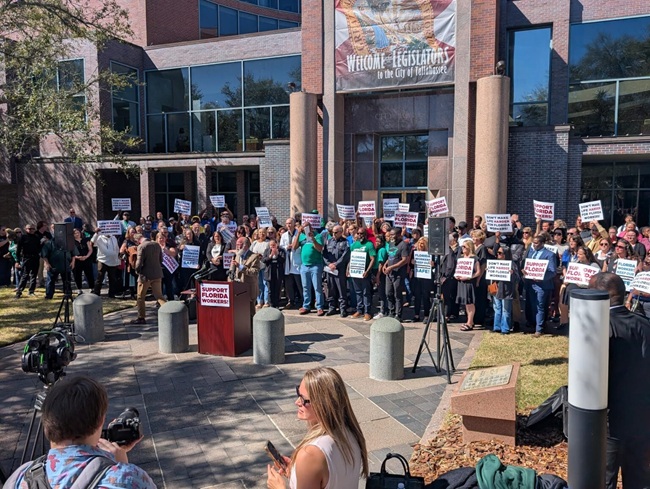
Earlier this month, more than 150 public sector workers came to Tallahassee to protest against the bill.
“If this bill is passed, resident physicians would be disenfranchised and unable to advocate for the conditions needed to deliver the care that all Floridians deserve,” said Casey Mohrien, who works as a resident physician in internal medicine and pediatrics at Jackson Memorial Hospital in Miami. “I look to my lawmakers so that I can continue to focus on my patients and not what’s going on in Tallahassee. Every day I wake up in the morning and I try to do right by my patients. I’m asking them to do the same.”
“I believe that legislators like you want to help working people like me, but I promise that this bill is not going to help us,” said Jodi Fiddia, a bus driver from Ocala, in a committee hearing. “If you want to help other public service workers like me, figure out how to make home ownership easier and more affordable. Whatever it is you choose to do to support public service workers, this bill should not be one of them. Please, because it does not help us, it only hurts us. Please vote no on this bill.”
The bill threatens the latest blow to public sector unions in Florida from state Republicans led by DeSantis in recent years. In 2023, the Legislature passed and DeSantis signed SB 256 into law. That measure requires teacher and other public sector unions (but not those representing police or firefighters) to stop automatically deducting dues from members’ paychecks, and required that union membership has to constitute 60% of a bargaining unit, an increase from the old threshold of 50%.
The passage of that bill into law has resulted in more than 100 public sector bargaining units representing more than 63,000 public employees in Florida being dissolved by the state.
Democrats and organized labor have blasted the legislation, arguing it flies in the face of most elections, in which the winner is determined by the majority of voters who actually participated.
Persons-Mulicka dismissed that argument, calling it “apples and oranges,” and pointing to similar requirements in Wisconsin and Iowa.
The House vote came five days after the Florida Senate approved its version of the legislation, 20-14, with five Republicans joining all the Democrats in voting “no.” That vote came after the Senate bill sponsor, Jonathan Martin, R-Fort Myers, amended the bill in its last committee to narrowly get it approved on a 12-10 vote. However, once it cleared that committee, he amended it on the floor back to its original language, which led GOP Senator Ileana Garcia to say that in her district, the voters “didn’t want it.”
“We amended it in [the Senate Fiscal Policy Committee],” she said. “We got to a good place. We rolled it back, and now Sen. [Alexis] Calatayud, Sen. [Ana Maria] Rodriguez, and myself, we’re left to give explanations,” she said, referring to two other Miami Republicans.
‘A deaf ear to workers’
Immediately following the vote, the Florida Education Association, the state’s biggest teachers union, said in a statement that it was “unfathomable that lawmakers turned a deaf ear to workers. ”
“After weeks of misinformation and falsehoods that were often presented as hard truths in the public record, politicians voted to strip away the constitutional right of thousands of workers in the state — including nurses, sanitation workers, utility workers, line technicians, certified nursing assistants, doctors and medical residents, city bus drivers, teachers, education staff professionals, higher education faculty and graduate assistants, city and municipal workers, communications workers, and countless other public sector workers who help make Florida safe and prosperous.”
Rep. Persons-Mulicka said the GOP-controlled Legislature has approved pay raises for school teachers over the past six years, but noted that several unions have reached impasses in contract negotiations over salary, blocking those teachers from securing pay raises. She said the right to collectively bargain belongs to the public employees, and not to the unions.
“The unions that are doing their job to represent our hardworking Floridians should be in favor of this bill,” she said. “They should want every union to do a good job. To be held accountable. To stand up and collectively bargain in favor of their members. But what we have seen is unions losing their way across the state. Not all, but many. That they’re putting politics over public employees.”

Florida Legislature Approves Restrictions on Public Sector Unions added by Staff on
View all posts by Staff →