

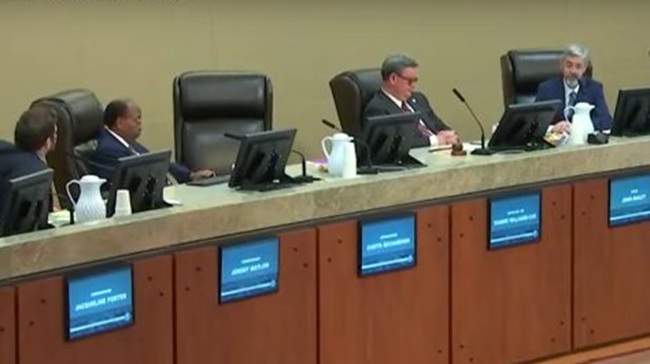
The Tallahassee City Commission voted unanimously Wednesday to suspend the city’s use of automated license plate reader cameras, reversing course just two weeks after a majority of commissioners rejected an effort to begin removing the technology.
The Sept. 9 vote applies not only to cameras supplied by Flock Safety, but also to other automated license plate recognition, or ALPR, technology used by the Tallahassee Police Department. TPD has been operating two ALPR systems — 80 Flock cameras and 75 Vigilant cameras — for a total of 155 cameras, according to information previously provided to commissioners.
The distinction is significant: Flock Safety is a company, while ALPR refers to the broader technology that photographs license plates and vehicle characteristics and makes the information searchable by law enforcement.
The unanimous decision represents a significant change from the commission’s Aug. 26 meeting. At that meeting, Commissioner Jeremy Matlow moved to begin removing the Flock cameras, with Commissioner Jack Porter supporting the effort. The proposal failed on a 3-2 vote, with Mayor John Dailey and commissioners Dianne Williams-Cox and Curtis Richardson supporting continued use of the technology.
Since then, the political and regulatory landscape surrounding license plate readers has changed rapidly.
The Florida Department of Transportation recently moved to revoke permits for ALPR cameras located on state highway rights-of-way and said it would no longer issue new permits. The state cited the rapid expansion of the systems along with concerns about misuse, data privacy and surveillance. Gov. Ron DeSantis has also said use of the technology had “gotten out of control.”
Leon County Sheriff Walt McNeil separately suspended the Leon County Sheriff’s Office’s use of ALPR technology while seeking stronger oversight and accreditation standards.
Williams-Cox said Wednesday that the city should follow the Sheriff’s Office and provide consistency in how the technology is handled locally.
The vote came despite TPD’s defense of the technology. Police officials have maintained that ALPR systems are valuable investigative tools that can help identify stolen vehicles, locate suspects and assist investigators in serious crimes. TPD had also outlined safeguards governing access to the system and recently joined LCSO in launching public transparency portals related to the technology.
But concerns over privacy, data sharing and potential misuse have fueled growing opposition locally and nationally. More than a dozen speakers addressed commissioners Wednesday and urged the city to discontinue the technology.
Matlow argued that public pressure was responsible for changing the outcome.
“This decision is only changing because of you,” Matlow told speakers, according to reporting on the meeting.
Matlow sought to go further, proposing that the cameras be physically covered within 24 hours and removed within 30 days. That proposal failed 3-2.
Instead, City Manager Reese Goad said the cameras would be turned off, preventing the city or others from accessing them through the system. The approach mirrors the Sheriff’s Office’s suspension of its cameras.
The action therefore amounts to a suspension rather than permanent removal. The cameras may remain physically in place for now, leaving open the possibility that commissioners could revisit the issue if new state rules, accreditation standards or other safeguards are developed.
For Tallahassee, the Sept. 9 vote marks a rapid reversal in a debate that has shifted from whether the city should use Flock cameras to the broader question of whether government should operate interconnected license plate-reading systems at all.




Be the first to leave a comment on this article.