


New economic analysis challenges the conventional wisdom that Tallahassee’s economy is stagnant, revealing a significant advantage for local families in housing affordability and household income.
Leon County ranks as the most affordable housing market among Florida’s 37 counties with populations exceeding 95,000, according to an analysis of 2024 home sales prices and median household income for married couples with children.
The findings offer a different perspective on Tallahassee’s economy, which is frequently characterized as stagnant because of its dependence on government employment, relatively modest private-sector growth and concerns about economic development.
The analysis indicates that Leon County has a significant economic advantage when housing prices are compared with the incomes of families most likely to be purchasing homes.
Leon County Leads Affordability Rankings
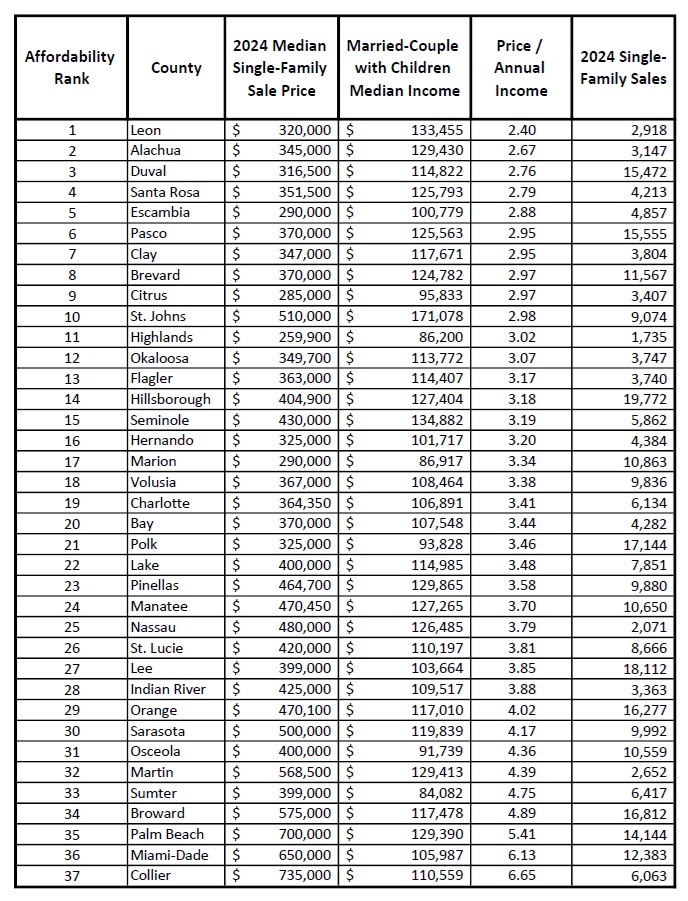
The analysis compares the median single-family home sales price in each county with the median annual income of married-couple households with children.
In Leon County, the median single-family home sold for $320,000 in 2024, while median income for married couples with children reached $133,455. This produces a home-price-to-income ratio of 2.40, the lowest among the 37 counties.
Alachua County ranked second with a ratio of 2.67, followed by Duval County at 2.76, Santa Rosa County at 2.79 and Escambia County at 2.88.
By comparison, Hillsborough County posted a ratio of 3.18, Orange County 4.02 and Miami-Dade County 6.13.
The results indicate that a typical single-family home in Leon County costs approximately 2.4 times the annual income of a married-couple family with children. In Miami-Dade County, that figure exceeds six times annual income.
Leon County’s advantage is not simply the result of inexpensive housing. Its median income of $133,455 for married couples with children ranks third among the 37 counties, trailing only St. Johns and Seminole counties.
This combination of relatively high family incomes and moderate home prices distinguishes Leon County from many of Florida’s larger metropolitan economies.
What the Rankings Say About the Local Economy
The findings raise questions about the conventional wisdom that Tallahassee’s economy is stagnant.
Economic performance is often evaluated using employment growth, population increases, construction activity and business expansion. While these indicators are important, they do not necessarily measure the purchasing power or financial well-being of existing residents.
For example, a county experiencing rapid job growth may also experience substantial increases in housing costs, reducing the economic benefits associated with higher employment and wages.
Conversely, a county with slower population and employment growth may provide residents with greater purchasing power if household incomes remain relatively strong and housing prices are more moderate.
Leon County’s affordability ranking suggests that the local economy is delivering an important benefit to married-couple families with children: greater potential access to homeownership relative to income.
The county’s large concentration of government, university, health care and professional employment may help support household incomes while providing a degree of economic stability.
However, the analysis does not establish that Leon County has a stronger overall economy than faster-growing counties. It measures one important dimension of economic well-being rather than job creation, business investment or economic mobility.
Affordability Could Be an Economic Development Advantage
The results also have implications for efforts to attract employers and workers to Tallahassee. Housing affordability is an important consideration for families evaluating employment opportunities and relocation decisions.
A community where a typical home costs less relative to family income may offer advantages in attracting experienced workers, particularly those seeking homeownership, financial stability and a lower cost of living.
For employers, this affordability advantage could help offset concerns about Tallahassee’s smaller private-sector employment base and more limited career opportunities in certain industries.
Still, the rankings have limitations. The analysis focuses on married couples with children, rather than all households. It does not capture affordability challenges facing single-parent families, younger workers, students or lower-income residents. It also excludes mortgage interest rates, property taxes, insurance and other homeownership expenses.
A Different Measure of Economic Success
The findings suggest that assessments of Tallahassee’s economy should consider more than how quickly the community is growing. Leon County may lag some Florida markets in population growth, construction activity or private-sector expansion while outperforming those same markets in the relationship between family income and housing costs.
The distinction is important.
For Leon County, the 2024 rankings provide evidence of a competitive economic strength that is often overlooked in discussions about Tallahassee’s economic future.
Methodology: The analysis compares 2024 median single-family home sales prices with median annual income for married-couple households with children in Florida’s 37 counties with populations exceeding 95,000. Lower price-to-income ratios indicate greater relative affordability for the household category examined.



Be the first to leave a comment on this article.