


Exclusive: Messages obtained by Tallahassee Reports reveal political consultant and city lobbyist Gary Yordon’s private communications with City Manager Karen Jumonville before a meeting in which he allegedly warned her that commissioners had the votes to fire her and discussed a possible exit arrangement.
Text messages, combined with statements from Tallahassee City Manager Karen Jumonville, raise questions about whether members of the City Commission used a political consultant to coordinate efforts to remove the city’s top administrator outside the public view. Jumonville said her perception was Yordon was acting as “an intermediary for the three as part of a conspiracy.”
The messages, obtained by Tallahassee Reports, document communications between political consultant and city lobbyist Gary Yordon and Jumonville, including references to conversations with political figures and efforts to arrange a private meeting with the city manager.
According to Jumonville, that meeting included a warning that commissioners had already secured enough votes to terminate her employment and intended to act on Wednesday, November 18.
“He basically told me that they have the votes to fire me,” Jumonville said, “and that they plan to do it on Wednesday.”
Jumonville, who described herself as “heartbroken,” also said Yordon discussed an arrangement that would allow her to step down as city manager while receiving a one-year contract as a city consultant.
The account raises a fundamental question under Florida’s Sunshine Law: Were elected officials discussing and coordinating the removal of the city manager through a private intermediary rather than deliberating in a publicly noticed meeting?
The Text Messages
The text messages obtained by Tallahassee Reports provide a window into the chronology and communications preceding Yordon’s meeting with Jumonville.
In the first group of text messages, Yordon writes “I thought you were the perfect choice” and indicates he had talked to every candidate and those already in office and said he “shared my feelings about how special you are.”
Yordon then said “I now have the ear of the majority” and indicated he had talked to Matlow and had a meeting scheduled with Porter. He concluded, “I think things will work out.” He added, “I had a long talk with Jeremy after the show, and Jack wants to meet with me on Thursday.”
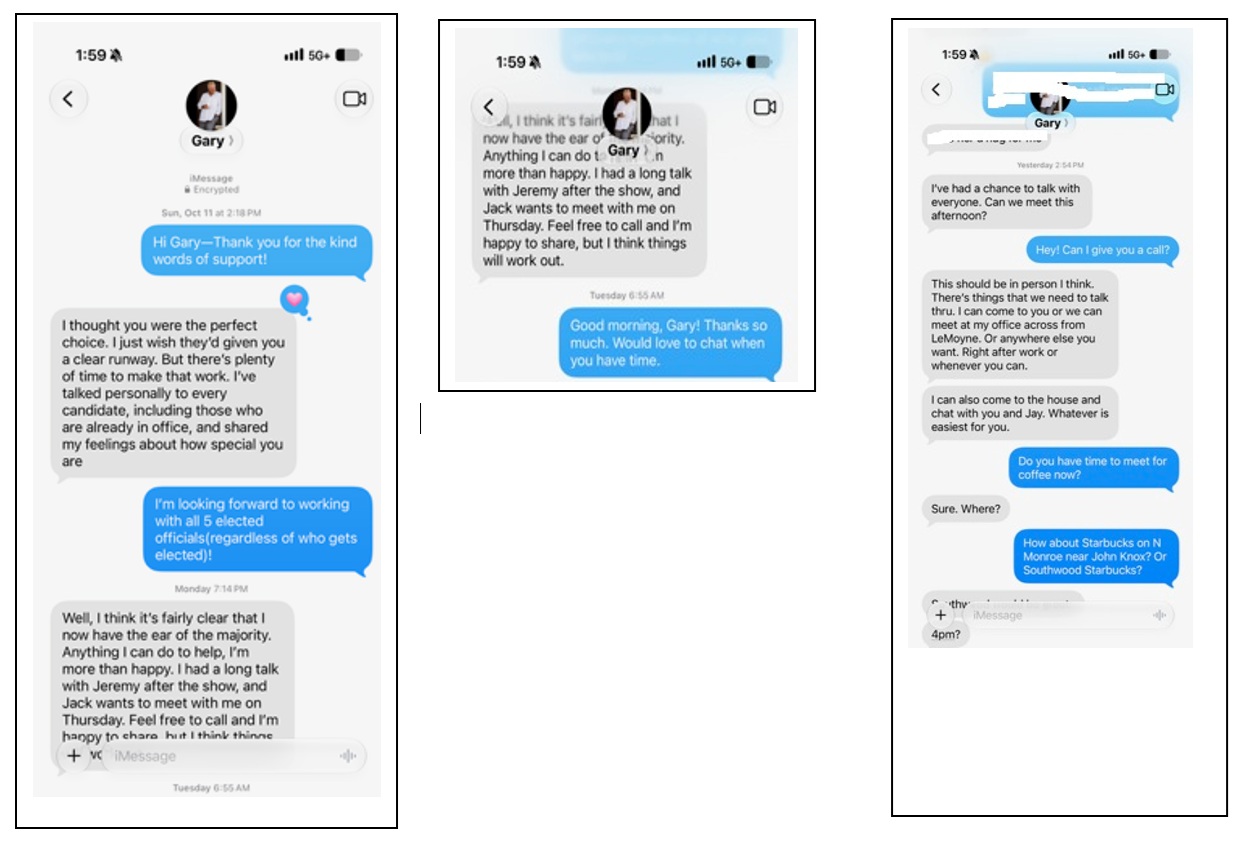
However, the tone of the messages changed when Yordon wrote, “I’ve had a chance to talk with everyone. Can we meet this afternoon?” Jumonville requested a phone call, but Yordon pushed for a meeting. “This should be in person. I think. There’s things that we need to talk thru.” he wrote.
Jumonville’s subsequent account of the meeting raises questions about whether Yordon was simply offering personal advice or conveying information obtained through discussions with commissioners.
Who Had the Votes?
Perhaps the most consequential statement attributed to Yordon is his assertion that commissioners already had sufficient votes to fire Jumonville.
Florida’s Sunshine Law generally prohibits two or more members of the same elected board from privately discussing matters on which foreseeable official action will be taken.
The prohibition also extends to efforts to circumvent public deliberations by using an intermediary to communicate positions between elected officials.
A Proposed Deal Raises Additional Questions
Jumonville’s description of the proposed one-year consulting contract introduces another issue.
According to her account, Yordon discussed an alternative under which she would voluntarily leave the city manager position but continue working for the city under a separate consulting arrangement saying “they” want to make easy for everyone.
Who developed that proposal?
Did any commissioner authorize Yordon to present it?
And had commissioners discussed or agreed upon the terms before the proposal was communicated to Jumonville?
Those questions are significant because the proposed arrangement would potentially involve the expenditure of public funds and a change in the city manager’s employment status.
A Florida Court Has Examined a Similar Case
A 2018 Florida appellate court decision involving the City of Port St. Lucie provides a notable comparison.
In Transparency for Florida, Inc. v. City of Port St. Lucie, 240 So. 3d 780, the Fourth District Court of Appeal examined allegations that a city attorney privately contacted individual council members concerning the city manager’s termination and a possible separation agreement.
The city attorney also approached the manager about leaving his position.
The appellate court reversed summary judgment in favor of the city, finding that disputed facts remained concerning whether the private communications violated the Sunshine Law and whether subsequent public proceedings cured any violation.
The ruling did not establish that a violation had occurred, but it underscored that public officials cannot necessarily avoid open-meeting requirements by communicating through another person.



Be the first to leave a comment on this article.