
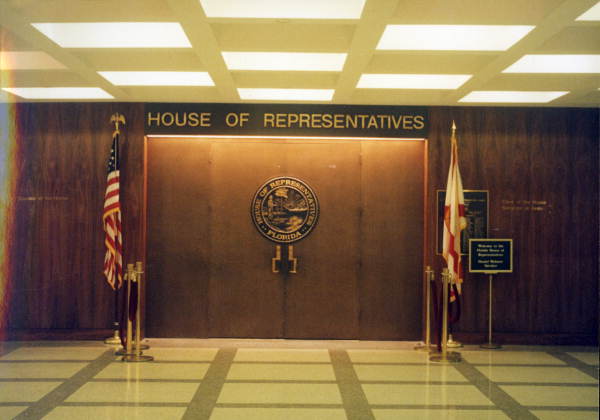


The state House continues to move a proposal that creates an exemption for some entry level jobs from the state’s voter-approved minimum wage.
The GOP-controlled House Careers & Workforce Subcommittee on Wednesday voted 11-5 along party lines to approve a measure (HB 221) that would allow people to waive their rights to the minimum wage if they are in a work-study, internship or pre-apprenticeship program.
A similar effort failed last year, and the Senate has yet to act on a bill (SB 1412) with similar language this session.
Supporters said the state’s minimum wage, which will increase to $15 an hour in September, limits entry-level jobs.
“They’re gaining a short-term, high-level experience that otherwise would not be available in the job market, that could go on their resume, and I believe will accelerate their earning potential in a much shorter time than it would be to go to two or three or four years of school,” said bill sponsor Ryan Chamberlin, R-Belleview.
Rich Templin, a lobbyist for the Florida AFL-CIO, said that some business owners could declare all jobs as “work-study” and compel individuals to waive away their rights for a needed job.
“All the power is with the business owner. None of it is with the workers,” Templin said. “And again, there is no guarantee whatsoever that this is actually an education program.”
Employers in Florida are allowed to pay sub-minimum wages to certain workers, such as people ages 19 and younger during the first 90 days of employment and to students working part-time in vocational training programs.
Under Chamberlin’s proposal, the “work-based” opportunities couldn’t last longer than 252 days or two semesters for people earning school or college credits. People 18 and younger couldn’t accept pay under the minimum wage for longer than 126 days or one semester when earning school credit.
The bill wouldn’t allow employers to go below the federal minimum wage of $7.25 an hour.
A 2020 Florida constitutional amendment required gradual increases in the minimum wage. It is $14 an hour and will go to $15 an hour on Sept. 30. For tipped employees, the state’s minimum wage is $10.98 an hour.

Minimum Wage Exemption Bill Moving in House added by The News Service of Florida on
View all posts by The News Service of Florida →
@Mr. Lusk
“Federal expenditures can easily be funded by treasury dollars…”
It appears that you may be one of those people who think that if the Federal Government needs money, they just print it.
Remember that, come April 15th, when you calculate your taxes and see how much YOU actually pay to the government in the form of taxes. Where do you think that money goes and what it’s used for?
Also, when you make a purchase in Leon County Florida, 6% of the cost goes to the State of Florida and 1.5% goes to the Leon County Government.
No, Mr. Lusk, when these governments need money they don’t just print it. You and everyone else gave it to them as required by law.
Let’s do away with both the minimum wage and income tax. Federal expenditures can easily be funded by treasury dollars without the costly rigamarole with targeted Deep state data mining and no employer is going to pay more than a worker is projected to contribute in value.
“They’re gaining a short-term, high-level experience ”
So, it’s ‘high level experience’, and simultaneously not worth the minimum wage? That’s some powerful doublethink.