

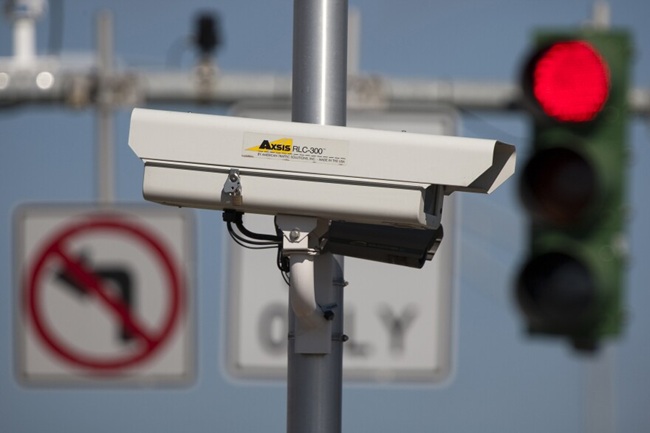
As communities across the country debate the use of automated license plate readers, new research provides evidence that the technology can reduce vehicle theft — while also raising questions about whether law enforcement agencies have adequate safeguards to prevent abuse.
A new study by criminologists Ian T. Adams and Scott M. Mourtgos of the University of South Carolina found that motor vehicle theft declined approximately 11% in the year after law enforcement agencies deployed automated license plate reader, or ALPR, networks.
The researchers describe their study as the first rigorous evaluation of modern fixed license plate reader networks, technology that has become increasingly common through companies such as Flock Safety.
The findings come as the Leon County Sheriff’s Office has suspended its use of automated license plate recognition technology pending additional oversight, guidance or regulation from law enforcement accrediting organizations.
The national debate over the cameras has intensified following reports of law enforcement officers improperly accessing plate-reader databases. According to Adams and Mourtgos, at least 50 officers nationally have been charged with or accused of misusing plate-reader networks, including officers accused of searching for information on wives, former girlfriends and other women.
But the researchers argue that those legitimate concerns should be considered alongside emerging evidence that the technology produces measurable public-safety benefits.
Their study examined installation records from a major ALPR vendor covering 216 law enforcement agencies and compared the information with monthly crime data reported to the FBI. Another approximately 1,800 similarly sized agencies served as the control group.
The strongest finding involved vehicle theft.
During the year following deployment of ALPR cameras, motor vehicle theft declined approximately 11% relative to comparison agencies. Researchers also found that other types of property crime did not experience similar declines, providing additional evidence that the change was associated specifically with the plate readers rather than a broader reduction in crime.
The study also found that vehicle-theft clearances increased approximately 16%.
However, the researchers cautioned against attributing the entire increase to ALPRs because arrests began increasing during the months immediately before the recorded camera activation dates. Police departments sometimes purchase the systems as part of broader initiatives targeting vehicle theft, making it difficult to isolate the effect of the cameras on arrests.
Another finding involved how quickly stolen vehicles were recovered.
The cameras did not significantly increase the overall percentage of stolen vehicles eventually recovered. But among vehicles that were recovered, recovery occurred approximately six hours sooner.
That distinction illustrates both the usefulness and limitations of the technology. A plate reader can only identify a stolen vehicle if it passes a camera, its license plate is readable and has been entered on a law enforcement hot list, and an officer is available to respond. Many stolen vehicles are instead discovered by their owners or found abandoned or crashed.
The study therefore provides evidence that ALPRs are useful crime-fighting tools, but not the broad solution sometimes portrayed by supporters.
Just as important, the research does not resolve the privacy debate.
Adams and Mourtgos acknowledge their study does not measure the costs associated with misuse of plate-reader databases. Police databases have historically created opportunities for improper searches, and the expanded reach of fixed camera networks potentially increases the consequences of such abuse.
Modern ALPR systems include safeguards. Agencies can examine officer search logs, and Flock has developed an automated auditing tool designed to flag suspicious searches. According to the researchers, that system recently contributed to a Georgia police department firing five officers.
But internal audits have significant limitations.
The researchers cite cases in which officers responsible for oversight were themselves accused of abusing the systems. They also note that audit logs are only useful when officers provide meaningful explanations for searches. In one Missouri community, 85% of searches contained only a single-word explanation and fewer than 3% were connected to a criminal case.
Adams and Mourtgos argue that the most significant missing safeguard is independent external auditing.
They point to FBI databases, where access has long been accompanied by mandatory audits and the possibility that access can be revoked. No comparable nationwide auditing system exists for ALPR networks.
The researchers recommend regular outside audits along with limits on how long license-plate information is retained and tighter restrictions governing who can search the databases and for what purposes.
The emerging evidence therefore complicates the debate over Flock cameras and other license plate readers.
The technology appears capable of producing a measurable public-safety benefit, particularly by reducing vehicle theft and helping police locate stolen vehicles more quickly. At the same time, documented cases of database misuse demonstrate that privacy concerns are more than theoretical.
The policy question may increasingly become not simply whether communities should use license plate readers, but what independent oversight should be required when they do.
Source: Ian T. Adams and Scott M. Mourtgos, University of South Carolina criminologists, analysis of their working paper evaluating fixed automated license plate reader networks.




Be the first to leave a comment on this article.